.png)
Mission, Mindset, and Media: The Growing Pains of Going Digital

What a 60-year recovery fellowship learned about showing up online — and what it means for any organization still doing things the way they've always been done.

Eternal Sunshine of the Recovering Mind.
That's what we called it. A conference drawing close to 1,000 people. Held at the LAX Hilton in Los Angeles. Themed like a film, branded like the mission deserved to be seen, run entirely through a website that hadn't existed in its current form twelve months earlier.
The bottom of the Save the Date read like a movie production credit: 'Directed by PRAYER & MEDITATION. Written by THE TOOL OF WRITING. Starring MEETINGS, TELEPHONE & SERVICE.' The design placed you at your own table — notebook open,
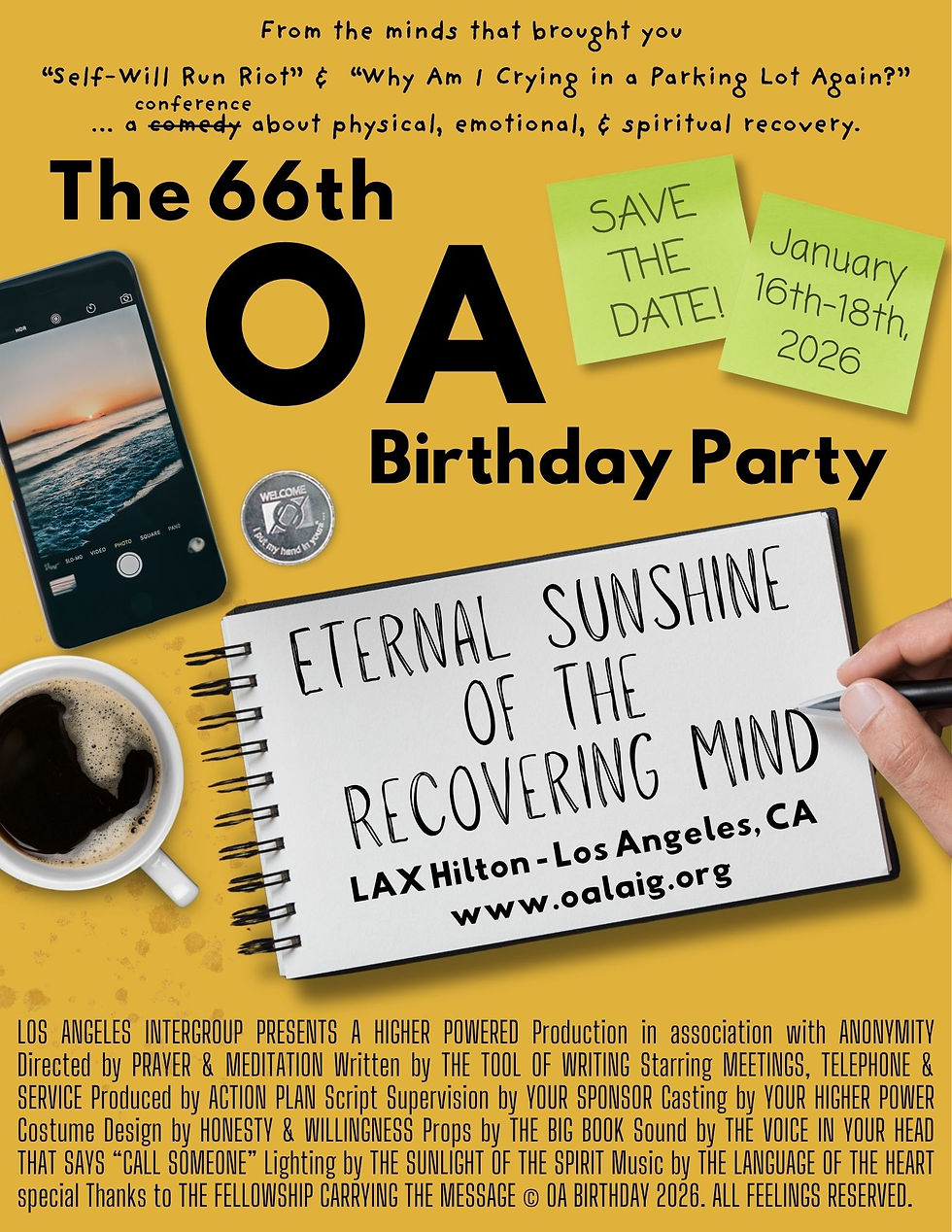
coffee beside you, pen in hand, OA chip within reach. Not 'come to our event.' You are already in this story.
Getting there took more than a rebrand. It took rebuilding the foundation underneath an organization that had been serving its community faithfully for over 60 years — and doing it in a way that honored everything that had made it worth preserving in the first place.
This is that story.
The Organization
Overeaters Anonymous was founded in Los Angeles in 1960. The Los Angeles Intergroup — one of the oldest and most active in the fellowship — serves hundreds of members across dozens of weekly meetings and produces one of the largest annual OA events in the country. The organization operates entirely through rotating volunteer leadership. The commitment is deep. The institutional knowledge is real. The mission genuinely changes lives.
What the organization needed was infrastructure that reflected all of that — digitally, operationally, and visually. Not a cosmetic update. A translation. Taking what the fellowship actually was in 2025 and making it visible, accessible, and usable in the world people are actually living in.
How OA Operates — And Why It Matters Here
Before describing the work, it's worth understanding how this organization is structured — because it shaped every decision we made.
OA operates under the 7th Tradition: fully self-supporting, declining outside contributions. No grants. No corporate sponsors. No outside funding of any kind. The fellowship funds its own mission entirely through member participation — event registrations, donations passed at meetings, merchandise sales, recording purchases.
This isn't just a financial policy. It's a values statement. It means every dollar raised through a digital channel is a direct investment in the mission. And every inefficiency in how those dollars are collected — a payment system that can't track by group, a ticketing arrangement that surrenders most of the revenue, a recording deal that leaves the majority of the value with someone else — is a direct cost to the fellowship's ability to serve its members.
It also means the infrastructure we built had to work within the organization's principles around anonymity, rotating leadership, and self-determination. We weren't brought in to impose a direction. We were brought in to serve one that already existed — and to build systems strong enough to outlast the people who built them.
That's a different job than building a website. It's the part that changes everything about how you approach the work.
Where We Started
When we came on board to rebuild the website and produce the annual Birthday Party, the organization's digital infrastructure reflected decades of doing things the way they'd always been done — which is to say, manually, across multiple disconnected platforms, with volunteer time absorbing the friction at every step.
Donations were collected through Venmo, tracked manually with no reliable way to identify which group had contributed what. The largest annual fundraiser ran through a third-party app that cost thousands of dollars and had no connection to the main website. The recording company contracted to capture conference sessions retained the majority of the revenue — the organization received a small percentage of its own content.
The monthly newsletter was a PDF posted to the website. The meeting list lived in a spreadsheet that required manual updates every time anything changed. Every piece of information lived somewhere different. Every task created a dependency on a person.
None of this was failure. It was an organization that had been running on commitment and goodwill, doing the best it could with what it had and what it knew. The question we were brought in to answer wasn't 'what went wrong.' It was: 'what becomes possible now?'
You can't make good decisions about tools you don't understand. And you can't ask for what you don't know exists.
What We Built — And Why
We moved the website to Wix — not a universal recommendation, but the right choice for a volunteer-led organization that needs to grow into its needs without requiring a developer every time something changes. From there, we built outward: email, community, events, content, operations. One platform. One hub. Everything connected.
But the infrastructure was always in service of something larger. The real test wasn't whether the systems worked in theory. It was whether they could hold a 1,000-person event, a community of hundreds of members, and 60 years of institutional identity — all at once, under pressure, in public.
The Birthday Party was that test.
The Website and Visual Identity
The rebrand was about making the organization look like what it actually is — a thriving, contemporary fellowship doing serious work in a city that never stops moving. The visual identity was built around Los Angeles landmarks: familiar, grounding, and humanizing for someone who might be arriving at the website in a difficult moment. The city isn't anonymous. The program is. That tension was the design brief.
The result was a site that felt new and fresh without feeling foreign. For a fellowship where the presentation of the program is itself a message — you want what we have — the appearance of the digital front door matters more than most organizations realize.
Email Marketing
The PDF newsletter became a fully integrated email platform connected directly to the website's event system. Automated reminders. Targeted campaigns. Announcements that reach members without requiring someone to manually compile a list and hit send every time.
Across 8 campaigns following launch, the platform generated 9,100 unique opens and 2,361 unique clicks. Open rates ran between 57% and 74% — against a nonprofit industry average of approximately 26%. Email became the highest-converting traffic channel on the site, with an 8% conversion rate nearly three times higher than organic search. Fewer sessions, same number of completed actions. That's what the right infrastructure produces.
Community Hub
We built an optional membership area inside the website — a space where members can find each other, locate speakers, connect with sponsors, and access fellowship resources. Fully anonymity-respecting. Completely optional. For a program that runs on human connection, this gave that connection a digital place to happen without compromising the principles that protect it.
Meeting Directory
The spreadsheet became a live, self-updating directory. Meeting representatives can log in and update their own listings directly. Changes go live immediately — no dependency, no waiting, no volunteer absorbing the friction.
Some longtime members preferred the familiar format. We built a secondary view that resembled the original to ease the transition. Not to avoid change — but to make the right action the easier action, and to bring people along rather than leave them behind.
Blog and SEO
Every business meeting announcement, organizational update, and event recap now lives as a blog post. The content that used to disappear into a PDF now accumulates online — quietly building search visibility, reaching people who are looking for help and don't yet know OA exists. The mission grows with every post, without any additional effort from the people doing the work.
The Event as Proof of Concept
The 66th Annual Birthday Party was where all of it came together. Ticketing, swag pre-sales, meal tickets, and merchandise bundles ran through the website for the first time — one system, one place, fully integrated.
The pre-sale model solved an inventory problem that had been quietly costing money for years. Previously, swag was ordered blind and whatever didn't sell on-site was a loss. Pre-sales matched supply to actual demand and generated revenue before the doors opened.
We restructured the recording arrangement entirely. Instead of contracting a vendor to sell recordings independently, we paid the A/V team a flat fee and sold the recordings directly through the website — bundled during the event and as standalone purchases afterward. The organization recouped its costs and generated profit after the event closed. Recordings continued selling throughout the year: a revenue stream that simply hadn't existed before, and one that reduced the pressure on ticket sales as the primary fundraising mechanism.
The branding was designed to do two things simultaneously: honor the fellowship's values and speak directly to the people the fellowship most needed to reach. Session names pulled from films that crossed generational lines. The Save the Date placed the reader inside the story before they'd decided whether to attend. The production credit at the bottom — 'Directed by PRAYER & MEDITATION, Starring MEETINGS, TELEPHONE & SERVICE' — was specific, warm, and fluent in both Los Angeles culture and recovery culture at the same time.
For an organization that depends on cultivating its next generation of leaders and members, that kind of intentional translation isn't aesthetic. It's strategy.
Operations
Social media, event promotion, email, ticketing, donations, the community hub — all of it flows through one platform. When leadership rotates, as it always will in a volunteer organization, the next committee doesn't inherit chaos. They inherit a system.
That was always the point.
What the Data Showed
The post-event survey captured 127 responses. 94% of respondents said the event supported OA's primary purpose. 23% were first-time attendees — a meaningful signal that outreach was working. 32% had attended six or more times — the longtime core still showing up.
Email open rates between 57% and 74%, against an industry average of 26%. Conversion rates nearly three times higher than organic search. A community hub giving members a digital space to connect. A meeting directory that updates itself. A blog that builds search visibility every time someone posts.
And an event that ran — for the first time — on infrastructure the organization actually owns, understands, and can build on.
The Weekend Companion workbook received near-universal praise. The fellowship spaces, the God box session, the hands-on programming were consistently cited as highlights. Named appreciation for the production team appeared organically throughout the open-ended survey responses — unprompted, repeated, specific.
The Part We're Not Going to Skip Over
Registration was difficult on Friday afternoon. Long lines, inadequate signage, a two-step check-in process that confused people who had traveled to be there. The event app needed better navigation and should have been shared before the weekend so people could plan in advance. Some recording files were inaccessible post-event for people who had paid for them.
These are real problems. The survey named them clearly. They'll be addressed.
The deeper friction was cultural — and worth sitting with honestly.
The modernization of the branding, the session naming, the programming direction all generated genuine tension within the fellowship. Some longtime members felt the event had moved away from OA's primary purpose. Others said it was the first time they had felt truly seen in years. Both of those things were true for the people who said them. Both appeared in the same survey, about the same event.
That's not a failure of execution. That's what organizational change actually looks like. When you modernize something people have deep identity investment in, you are — by definition — asking them to trust that what matters most will survive the change. Some people extend that trust readily. Others need more time, more evidence, more patience.
The patience piece is not incidental. It's the work. Bringing people along — not dragging them, not leaving them behind, but actually walking alongside them through the discomfort of something new — is what separates modernization that holds from modernization that fractures.
"This was the first time I have seen it done so beautifully. It really was extraordinary. I felt like OA had come of age." — 2026 Birthday Party attendee
Another attendee was equally direct in the other direction.
Both were telling the truth. That's the nature of this work.
What This Has to Do With Your Organization
The specifics here belong to OA Los Angeles. But the pattern belongs to every values-driven organization navigating the same moment.
You have a mission that matters. You have people who believe in it. And somewhere in how you operate — in the way you communicate, collect donations, run your events, show up online — there is a version of 'this is how we've always done it' that is costing you more than you realize. Not because the people are wrong. Because the tools haven't kept up with the mission.
What the OA story demonstrates is that modernizing doesn't mean abandoning what made you worth preserving. It means translating it. Taking the values, the community, the institutional wisdom of decades — and building systems that make all of it accessible to the people who need it most, including the ones who haven't found you yet.
The event is where it becomes real. Not the website launch, not the email platform, not the new meeting directory — the moment when everything works together in public, under pressure, with real people in the room. That's when the organization sees what it's actually capable of.
That moment is available to any organization willing to do the work to get there.
CC:Me — Conscious Creators Media helps values-driven organizations modernize how they communicate, organize, and engage. If any of this sounds familiar, the conversation starts with an honest look at where you are.
Comments